
Wednesday, June 18, 2014

“What do you hope to get out of this?”


world traveler off on another adventure
"What do you hope to get out of this?"

Well, that’s a sure fire way to set oneself up for disappointment. As a retreat leader, I used to ask that question to help determine which kids were really ready for the retreat experience. Nine times out of ten, the ones who said they were looking forward to “the crying part” or were expecting a profound spriritual experience were the ones who left slightly to strongly disappointed at the end. I remember one such student angrily berating me and the entire retreat staff at the end because she didn’t think she or her classmates cried enough or that the experience went deep enough. The ones who answered by saying they honestly didn’t know what to expect were the ones who were most likely to have a genuinely moving experience. The same goes for pretty much every adventure we go into. When we enter with specific expectations rather than general hopes, we are setting ourselves up to be let down, putting unrealistic responsibilities on all the people we interact with – whether or not they are aware of them, and lessening our chances of having unforeseeable but incredible experiences.

This was a hard concept to explain to the high schoolers and is a hard concept to explain to my daughters now. The challenge is anticipating enough to be prepared, but then letting go and just participating in the world as it comes. We have to find a balance between planning and just going with the flow.

When my older daughter and I went to Ukraine, learning this lesson was a huge part of the adventure. Before leaving, we talked about having an adventure spirit. I explained that we couldn’t control everything that happened on our trip, so we shouldn’t go with specific expectations. We looked through a guide book and talked about things we had done on previous trips to get general ideas about the kinds of things that might happen. We picked a couple goals – improve our Ukrainian language skills, see some historical locations, relax – and packed to be prepared for anything. We made an adventure journal and set off.

unplanned, totally blissful hammock adventure in the Carpathian Mountains

Each day, we would remind each other to find the adventure in the day. When weird, unpredicted things happened to us, we would say, “well, this is an adventure!” Each evening, as we were winding down and getting ready to sleep, we would talk about, “what was your favorite adventure today?” Adventure became our key word and a great way to turn discomfort into smiles. It wasn’t always easy. Some days the adventures were seriously uncomfortable, irritating, and sometimes even a bit scary. We got through it all, though, and came away with some amazing memories.
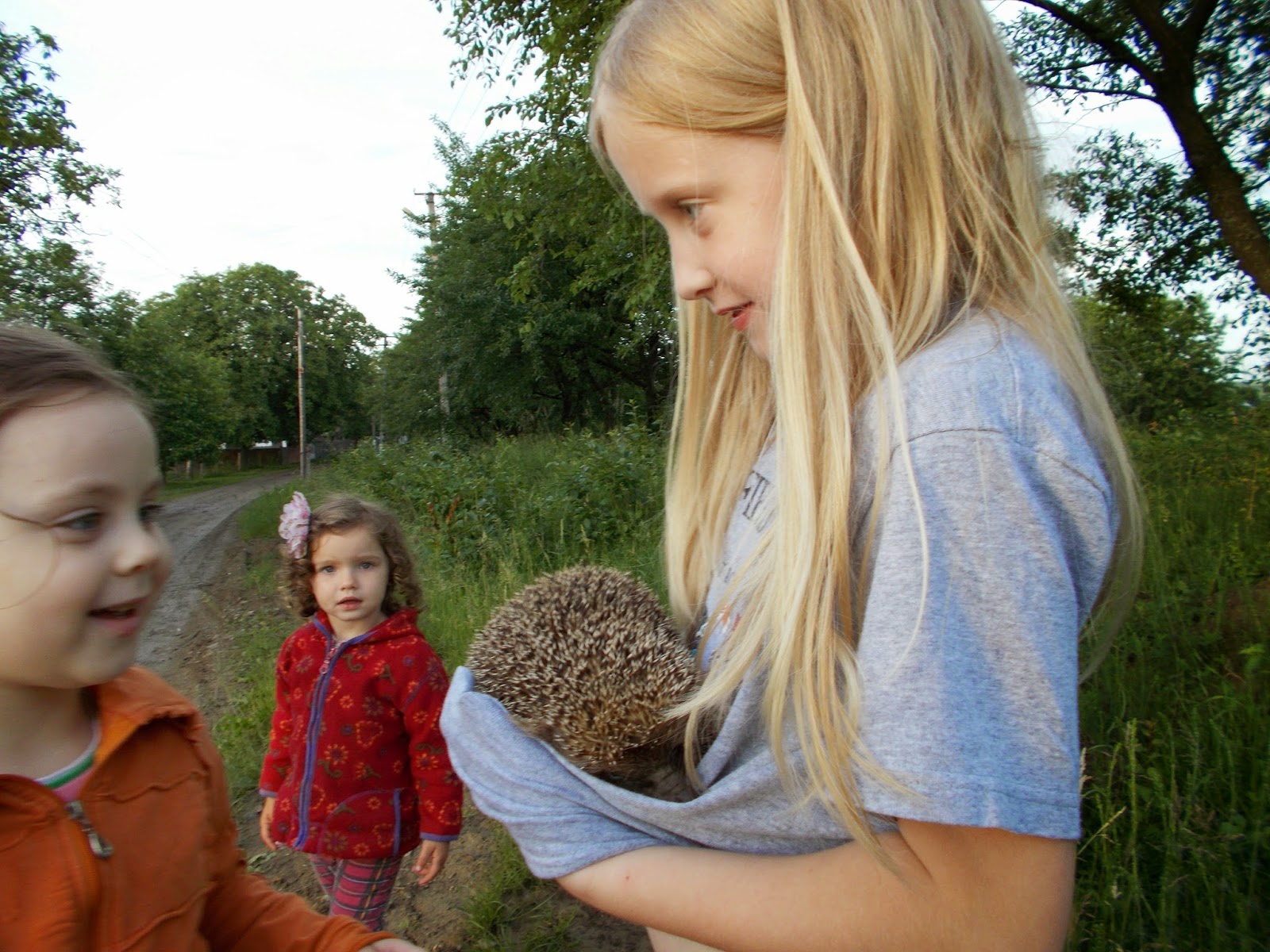
real wild hedgehogs discovered while cherry picking

Reminding ourselves to participate instead of anticipate helped us to focus on the incredible things that were happening around us – tiny frogs covering sidewalks, mud wraps, hedgehogs, cherry picking on the border with Romania – instead of focusing on the things that we couldn’t control such as how other people behaved, the weather, the food options, etc.

Here are some key things to try to do to find that balance between reckless flying by the seat of one’s pants and being overly expectant.

  1. Think in broad terms while packing if you are having an adventure far from home. Are you packing that dress for any special occasion or are you anticipating finding a great disco and dancing with a tall handsome stranger with dreamy blue eyes and a melt your knees accent (that did happen to me and is why I now have two children)? Are you daydreaming about really detailed adventures you’d like to have, repeating those details in your mind, or are you daydreaming about multiple, varied what-ifs? This is where my older daughter really struggles.  She likes to put together the most intricately detailed plans for what will happen even down to what other people will say, what shoes she’ll be wearing, what the weather will be like, etc. In other words, impossible plans.
  2. Read guide books to get ideas, but not to make minute-by-minute itineraries. No matter where you are going, weather, traffic, and unforeseeable events can spoil the best made plans. When we are traveling, we put together target lists or lists of things we think would be fun to check out or try. When we get where we are going, though, we don’t see that list as must do’s. We remain open to finding a different experience. Our list is sort of a jumping off point or back up to finding something better once we get places. My husband loves chatting with new people, so he usually makes a new friend and then finds out from them if our target list is good or if we’d be missing cooler things. The chat is usually the most memorable adventure of the trip although there is no way we could plan on finding friendly people everywhere we go. 
    The kittens she found at every place we visited were
    the highlights of the trip for her,
    something not included in any guide book.
  3. When you talk about hopes and goals, leave room for interpretation. Hope is a vital part of being a happy walrus. I need hope. My girls need hope. Goals are important, too. Goals are what drive us forward and ensure personal progress. When we talk about hopes and goals, we try to keep them general. We hope to make new friends, but don’t limit what kind of friends. We hope to learn new things, but don’t limit where that knowledge will come from. We hope to be nicer people, but don’t limit who we will be nice to or how the kindness will manifest. For goals, we set a goal that relies primarily on our own actions, e.g.  grades, polishing hockey or gymnastics skills, sending out a certain number of applications each month, sewing a certain number of items for the shop. We then approach those goals knowing that we may need to change strategies, find help down the road, or take longer than we initially thought.
  4. Practice finding adventures every day. Even when we aren’t on vacation, we try to have adventure days. Sometimes the adventure is just going to the playground and meeting someone new. The other day, we had an adventure when our dishwasher broke and the maintenance guy came to fix it. He turned out to be a very friendly, super interesting new friend. By trying to find the adventure in every day, we get in the habit of thinking “this day holds something really cool” and letting it happen rather than trying to force it. As my girls get older and the more we practice thinking in terms of appreciating the adventures that happen, it gets easier for them to stop whining about what they want to happen and genuinely appreciate what is happening.

This is all a work in progress, but I am hoping that by learning how to find adventures my daughters will be able to go through life creating memories, collecting cool stories, and avoiding the frustration that comes with expecting specific experiences, feelings, or actions from others, and that is a good, general hope.

my husband's great-aunt and a true expert of joy finding and adventure leading

Thursday, February 20, 2014

"You may think I'm not powerful, but I am very powerful."

It is not easy to be a little kid.  There is a lot that cannot be done when one is six years old and barely four feet tall.  That being said, what can be done is incredible.

My husband, parents, in-laws, and I are news watchers and don’t like to sit idly by when we see something we don’t like.  Since their births, our girls have been involved.  Our older daughter was born in the middle of the Orange Revolution and was included in her grandfather’s book which chronicled the events of the revolution.  You could say she was born into political consciousness and fighting for social justice.

At four years old, she decided she wanted to help other little kids in Pakistan and Afghanistan after she learned they needed more school supplies.  Her preschool did a penny drive for Pennies for Peace, but she wanted to do more.  She set up a lemonade stand during my mother’s garage sale.  Filled with a sense of importance and power, she approached every person and told them why they needed to buy lemonade from her, showing them a poster she put together with help from her grandmother.  Penny by penny, nickle by nickle, she raised several dollars and sent them off with a feeling of real accomplishment.


Now it is her little sister’s turn to change the world.  Last year when I shaved my head to raise money for children’s cancer research with St Baldrick’s Foundation, my younger daughter said she wanted to participate, too. At the time her father and I thought she was too young.  We were worried about the physical discomfort of it for her as well as questioning whether or not she fully understood what the event was about. To her credit, she didn’t forget about it or lose focus.  For the last year she has been talking about shaving her head as she watched my hair grow back.  When her school started talking about St Baldrick’s this year, she instantly said she wanted to be a shavee.  We told her to think about it for a couple weeks before we would sign her up.  Again, we wanted to be sure she really knew what she was doing.  We had a lot of conversations about it, and she made a pro and con list. In the end, the only negative she could come up with was her uncertainty about what the actual shaving will feel like.  After her father test buzzed a patch behind her ear, she was 100% ready to go.  We signed her up, and she set her first goal.  “What did you raise, Mama?  I’ll raise more than you.”  She did! In less than 24 hours she reached her first goal of $420. She created a video so she could tell people herself why she was going to shave her head (and compare herself to a Dalek). In less than 48 hours, she passed her second goal of $806.  She has continued to raise more every day since then.


The coolest thing?  It doesn’t surprise her.  She assumed people would want to help children with cancer.  She assumed her voice would be powerful enough to draw people to her cause.  When I told her she hit her first goal, she looked me square in the eyes and said, “I want to raise more.”

This feeling of power is not a selfish power.  She is powerful in her ability to help others.  She wants to raise money for someone else, for children with cancer and for their families who are sad. This sense of power and responsibility spills over into other areas as well.  The girls understand that their actions affect others and that they have a responsibility to contribute positively to their community.  This affects how they treat their classmates and teachers.

We want our kids to be kids and have carefree lives, however we also want them to feel that they can use their voices, that their voices deserve to be heard, and that they should try to fix things when they see injustice.  I do worry about burdening them with too much social responsibility and too much knowledge of the evils of the world.  We heavily filter what info they get from the news.  For example, as we have been glued to the news coming from Ukraine (my husband’s home country), we have only told them basic information.  They know people have died and are being hurt and that Kyiv is on fire, but they don’t know about the torture or see the pictures.  We constantly assure them that their grandparents and other relatives are staying safe.  We show them their grandfather on the news safe and sound to add extra comfort and peace of mind.  Still, they care and want to help.  My younger daughter very seriously put her spoon down during breakfast this morning to tell me, "I want to go to Ukraine. I want to go and find the bad guys and tell them to stop hurting Ukraine. I'll say, 'God loves you and you are supposed to not hurt people.' I really want to go and help the people." I told her we couldn’t go to Ukraine right now, and she glared at me a bit.  Later she asked how much longer till she shaves her head.  I answered three more weeks and she replied, “good.  Then I have time for Ukraine.”  It is certainly tricky trying to keep them in the loop without feeding them too much info or causing too much worry.  Because, in terms of the Ukraine situation, she seems to have set her mind on being a hero again, we will have to come up with a way for her to feel she is using her powers once more.  And then, hopefully, she can spend some time just playing with her Legos or having snowball fights.


If at six years old she has already taken on fighting cancer and an Eastern European bloody regime, what more will she do as she gets older?  And how much can the two girls together accomplish?  And how much can the world change if more little girls embraced the power they have?


Want to help her "save little kids and make their families happy"?  You can donate here. 


*Update* Since she couldn't go to Ukraine is person, Yaroslava sent a message instead.  She made cards for her grandfather to share with people there, and she created this video for them.

Пісня Ясі для людей в Україні from Alex Yanevsky on Vimeo.

Tuesday, October 8, 2013

"Mommy, I play hockey!"


The other day someone said to me, “Oh, our little girl will never play hockey.  Her daddy would never let her do that!”  Now, I know not every little girl will be a hockey player, but to me it was a bit baffling to hear someone completely rule it out as an option before their daughter is even two.  I asked, “But what if she wants to?” The other mom smiled and said, “No, really, her daddy will not let her play hockey.” 

My daughter does play hockey (as have many other daughters for a long time including Lord Stanley's daughters as well as a whole Olympic team of daughters), so this seemed like a strange line to draw.  There are some negatives – rinks are cold places to have to spend hours each week, it’s an aggressive sport with lots of crashing into each other, the gear and fees are not cheap, it’s a huge time commitment once they get to the travel teams (but thankfully my princess is still doing in-house).  But those same things are true for most activities.  Overall, I have learned to love hockey.  I see how much joy it brings my daughter and the ways it has helped her off the ice. 
 
Our happy little four year old princess loved to skated along the
center the line, back and forth, during free time.
She started skating lessons when she was three because she demanded it (she knows what she likes).  She would pretend to skate everywhere yelling to me, “Mommy, I want to skate!”  She would take whatever she could find and swing at invisible pucks.  “Mommy, I play hockey!”  So we got her in mom-and-tot skating classes which were an absolute joke because I can’t skate to save my life!  As a kid, I dabbled in ballet, gymnastics (very briefly), and modeling (through my teen years).  Yeah, I can’t skate.  When she was four I very happily moved her to the hockey basic skills classes, and she has never looked back.

Me doing what I do best - sitting and smiling
and not participating in sports.
See how serious he was?
Good luck getting him to dance now!
Her daddy’s only fear for her when she started hockey was how damaging the competitive nature of the sport would be.  He grew up in the Soviet Union and was put in competitive ballroom dancing as a kid.  The super strict competitive atmosphere was pretty traumatic.  Less than perfect children were ostracized severely.  When he saw the coaches laughing with Sofi and patting her on the back when she improved, patiently encouraging her when she struggled with a skill, he relaxed and said she could keep going.

I know some parents start choosing sports or activities for their children before they are born, buying cute tiny catcher mitts or ballet shoes, planning lives filled with activities.  When she was born, we weren’t sure our daughter even had any life ahead of her at all.  She was as close to dead as a baby can be.  I didn’t even get to see her in person until she was a day old because they were working so hard just to get her stabilized.  She proved she is a tough cookie by beating the odds and smashing through every obstacle in record time.  We want her to have a great life now that she has worked so hard to have one at all!

At this point, who cares what sports they grow up to play
as long as they get a chance to grow up!


So why do we let our precious pretty-pretty-princess play hockey?  Other than the fact that she loves it and really wants to? 
  • Being in a team sport teaches her to think beyond herself and to see how her actions affect the success of others.  When she works hard and plays her best, her team does well.  When she doesn’t pay attention or turns into “blombie” (her dad’s name for our blond zombie), she doesn’t guard the net and doesn’t pass the puck to her teammates to help them score so her team suffers.
  • Hockey teaches her to accept responsibility for her actions and also gives her new responsibilities similar to ones she will face later in life.  She must keep track of her gear.  If she forgets her stick or water bottle, that’s on her just like if I forget my wallet or phone that’s on me. 
  • She also knows she isn’t alone in her battles.  When things get tough, she has a whole group of guys behind her, watching her back and cheering her on.  When they played against an overly aggressive team and a kid started saying, “girls can’t play hockey,” my daughter’s teammates jumped to her defense and loudly spoke up for her. 
  • She is learning that not everything is easy at first, so sometimes she needs to put in extra effort before she sees results.  A lot of things just come easily for her.  She picks up on stuff pretty quickly.  When she doesn’t, she can get thrown for a loop and get discouraged.  When that happens, we remind her about crossovers, a hockey skill that she struggled with at first but now has no problems doing.  She says, “Oh, yeah, I had to practice and it took a while for me to learn that.”  Taking time to learn things is ok.  Giving up when she isn’t perfect right off the bat is not.  Thankfully none of her coaches or teammates has ever demanded instant perfection.  They all recognize success and identify weak areas as areas to work on in a productive manner.
  • Hockey reinforces the lessons she learns in health class.  If she doesn’t eat enough before hockey, she is hungry and sluggish.  If she doesn’t bring her water bottle and stay hydrated, she feels sick.  She tries to stay in shape year round and eat healthy so she can be the best hockey player during hockey season.  That kind of self discipline will benefit her her whole life!


As I have said before, if we had limited our daughter to things we have experience with or things American society has labeled as girlie, life would be pretty boring.  We love watching our daughter flourish and grow in her chosen sport. We love seeing how it is helping her become a stronger person both physically and mentally.  We love learning all about a new sport and meeting new, interesting people through it.  We don’t know what will happen in the future, but for now we are happy hockey parents.

Playing in the backyard with her little sister (who doesn't skate at all).

Friday, October 4, 2013

“I want Ciacia back!”

“I want Ciacia back!”
“What?”
“I want Ciacia back.  I want her to come back.  Now.”
Then it clicked in my head.  My tearful six year old was talking about my aunt, my dad’s sister who went by Ciacia.  She had passed away the previous spring after a very long battle with cancer.
“Honey, she can’t come back.  She is in heaven and has to stay there.”
“But I want her back.  She was the nicest, bestest person ever, and I need her to be here right now.”
That’s when I turned into a fish.  I mean, my mouth kept opening and closing, but no words would come out.  I had no idea what to say.  I was completely blindsided.  If this had happened months ago, closer to the death, I would have been more prepared because I would have expected it.  But not that day.  Not on a sunny October afternoon as we walked home from the bus stop.  I looked at my daughter’s genuinely sad eyes and my own welled up, too.
“I know.  I want her back, too.  We all do.  But she has to stay where she is.”
Came across this on our trip to Ukraine.
That's her name and it was a neat reminder
that she is still with us in spirit.
Then I admitted what I do when I am missing her.  Actually, I do it on an almost regular basis and have always been a little scared to admit it because it seems pretty crazy.
“When I miss Ciacia, I talk to things that remind me of her, things we got from her.  She gave us the dryer, you know, and that always reminds me of how much she loved our family.”
So my little girl went into the laundry room, closed the door behind her, and had a private conversation with the dryer.
I know this sounds very odd.  And picturing it, picturing us talking to our dryer, is almost giggle inducing.  But if you knew my aunt you would understand how hard it is to let go of her.

When my grandmother died, my older daughter was pretty shaken.  Even though she was just a preschooler, she and my grandma had a special bond.  She visited Great Marge often, playing simple games with her or just dancing around her room to make her smile.  My grandma had dementia and couldn’t remember most people, but she remembered Margie or The Margaret Baby (my daughter was named Sofia-Margaret after my grandma who liked to forget the Sofia part).  After Great Marge died, my daughter started keeping a picture of her in special places (now it is on the bookshelf next to her prized hockey trophy) and carrying a handkerchief Great Marge had given her.  She says these things help her remember Great Marge and how much she loved her.

She never forgets to visit Great Marge's memorial.  That's the handkerchief in her hand.
It is really hard to help children through loss when we ourselves are wrecks inside.  With my girls, all I can do is be honest with them.  The people aren’t coming back and it hurts and it sucks.  Together, we try to focus on the memories and the lasting legacies.  How are their spirits continuing on?  What projects did they set in motion?  What lessons did they teach us which we can now put into action?  We try to remember how much they loved us and how much we loved them.  We try to honor them by living good lives.  And we hug each other and cry sometimes.  And sometimes we talk to the dryer.

Thursday, August 22, 2013

School Struggles

While my girls are loving their teachers, our neighbor is struggling with his.  His poor mom was in tears this morning saying she doesn't know what to do, and people are making her feel like a bad mom because she lives in this town.  No!  We are not bad moms for living where we can afford to have a house in a safe neighborhood.  And, for pete’s sake, get realistic people.  Our school is not perfect, but it is not the worst out there either.  When we were preparing to move, my husband and I researched all the school report cards and talked to as many parent educators as we could to get the real scoop on the schools around here.  When we balanced what we could afford with the best schools, this is where we ended up.  I don’t think that makes anyone a bad parent.  Plus even in the best schools, a kid can have a negative experience.  Teachers are human, and their personalities might not mesh with every parents’ or students’.  Maybe my girls have gotten lucky with their teacher assignments or maybe he has just been unlucky, but either way saying his bad experience is the fault of the parents for choosing to live in the house they have is wrong and not at all productive.

So what can parents do if their students are not getting on well with their teachers?  A lot!  There are very few hopeless situations in parenting.  We can do plenty.

  1. First, set up a face to face meeting with the teacher.  Don’t just go straight to the principal based solely on the information from your kid.  This isn't calling your kid a liar, but it is acknowledging that he is a kid and is giving you his point of view.  You need both sides if you are going to find a solution.
  2. Stay calm and be mature.  This is hard because as moms, we do turn into grizzly bears when our kids are hurt.  We need to swallow our animal instincts and remember that we are mature adults, professionals in our fields, normally rational and capable of speaking without swearing.  Once we start attacking the teacher or name calling or acting like a spaz, our ability to work with the teacher goes out the window.  The goal isn't to put the teacher in her place; it is to find a way to get the teacher and our child on the same page so our child can succeed.
  3. Stay away from toxic people who will get you wound up.  People love gossip, especially negative gossip.  People love to pass the blame, and teachers are easy targets.  You will have no problem finding parents who will happily jump on the “that school/teacher/district is terrible” bandwagon.  There are parents who Facebook stalk teachers from their children’s schools and spend hours ranting about them (because teachers are super human saints who aren't allowed to have social lives?).  That time could be better spent building strategies for your child’s education.  Toxic haters will sabotage your child’s success, so just walk away.
  4. Be honest.  Yeah, admitting our kids can be naughty isn't something we want to do, but it is something we have to do sometimes.  It is possible that problems with teachers are not solely the problem of the teacher, so be honest about what kinds of bad behaviors your child is capable of.  Also be honest about where your child is coming from. Be honest about how your child feels so the teacher knows.  Be honest about your child’s needs, especially if they are special needs (ie: kinetic learners need to be in motion, etc.).  Hopefully the teacher will be honest as well, and together, given all the information, you can make a plan.
  5. Stick to the plan.  Once you and the teacher have put together a plan, stick to it!  Whatever you do, do not bad mouth the plan to your kid.  That is sabotaging the whole thing.  Changes take time, so be patient. Be encouraging.  Hide any frustration.
  6. Don’t turn dinner time into teacher bashing time.  Whatever you do, no matter how frustrated you get, no matter how much you think taking your child’s side means attacking the teacher, don’t do it.  If children will succeed in school, they need to have at least some level of respect for authority.  Sure, articles about rebels making awesome adults are interesting, but realistically it is a minority of rebels who become Bill Gates.  Your child needs to respect and trust his teacher if he is going really put his full effort into working with her.  Rolling his eyes at her suggestions for improvement won’t get him anywhere closer to a good school experience.  Be the grown up and dig deep to find positives.
  7. If at first you don’t succeed, try again.  You can keep meeting with your child’s teacher.  Really.  Unless the teacher is a truly horrible teacher, he or she will want your child to succeed and will be willing to continue working with your family.
  8. If that doesn't work, go up the ladder.  If you are getting no where with the teacher and half the year has passed, then contact the principal to request a face to face meeting.  Like I said, teachers are human.  If you do get one who really won’t work with you or your child, you can speak up.  Be sure to not jump to the principal until you have made several attempts with the teacher however.  If you just go in ranting, they will send you back to the teacher and you will lose credibility.  If you go in calmly, list all the details of what has happened, all the efforts you and your child have made without success, then you will be more likely to get the principal’s ear and be able to bring about significant change.  Again, though, you must be sure to act like the mature adult and not the spazzing monster mom biting everyone’s heads off (which is so tempting).
  9. If THAT doesn't work, keep climbing the ladder.  Sadly, sometimes principals can be hard to work with.  In that case, keep going up and bring the issues to the superintendent's attention.  Again, be calm and specific listing all your attempts with the teacher and principal.  You will be taken much more seriously if you are calm.


I do hear often from other parents their complaints about schools, and they say, “yeah, but you are from a family of teachers, so you never have problems with them.”  Yes, I am from a family of teachers.  Yes, my background is in education.  Yes, my friends are teachers.  That just means I understand that teachers are working hard.  Teachers are not always perfect (trust me, I wouldn't want my kids in the classes of some of the people I studied education with in college).  But I also know parents can work with teachers.  I know treating teachers as professionals and partners in this whole child raising thing goes a lot further than treating them as sub-level human servants trying to take all our tax money while all they do is give our perfect angels demerits.  So talk to your children and talk to their teachers and be a team.  Amazing things can happen when parents and teachers combine forces instead of fighting against each other.

Returning at the end of a rough day, shouting, "I had an awesome day at school. After I got there, I stopped crying and did all my work. I love school!"

Thursday, August 15, 2013

“Mom, I am glad I am one of a kind. I am unique.”

first day smiles

This week my girls headed back to school.  After all the drama and tears of the past couple years, I was prepared to be putting my older daughter on the bus with a lump in my throat, worrying about all the “what ifs” that came true in the past – kids teasing her for playing hockey or liking science, girls refusing to sit with her at lunch because she wasn’t girly enough, boys refusing to play with her because she is a girl, and on and on.  Imagine the relief I felt then when, the day before school started up again, she told me she was excited about the new year and said, “Mom, I am glad I am one of a kind.  I am unique.”

Where had this newfound strength come from?  This is the same girl who just a couple months ago was shyly snuggled next to me on a park bench saying she was afraid to approach the other kids because they might not accept her.  This is the same girl who cried after school on a regular basis because of how the other kids were treating her.  Somehow, seemingly overnight, she had changed.  After putting her on the bus and watching her eagerly wave good-bye to me, I had time to sit alone and think about it all.  Slowly, the pieces of the puzzle started to drift together.  She gained confidence in herself and an appreciation for her uniqueness because of the strength of others, because people spoke up when they saw her being her. 

At the start of the summer, she was still feeling very down about herself and hesitant to try to form relationships with other kids.  When we went to Ukraine, she stayed glued to my side at first.  We would sit at the playground and watch the other kids running around.  I would urge her to introduce herself, but she would bury her head under my arm and say, “what if they are mean to me?  What if they don’t like me? What if they are like the kids at school?”  

Thankfully, there was another person there.  My husband’s cousin quietly praised her.  She invited her to go places and then bragged about her to others.  That little nudge was enough to get my daughter off the park bench.  If a cool medical school student thought she was not all bad, maybe the kids at the park might be ok with her.  They were.  Of course, not all of them clicked with her, but a group did, and the ones who didn’t just left her alone.  The ones who did, the boys who bucked tradition and ran around playing with the little blond girl, gave her the next nudge of confidence.
This is what support looks like.

The adults we have been lucky enough to surround our daughters with are incredible.  Instead of calling her weird or ignoring her, they have been very vocal cheerleaders for her.  That is critically important because praise coming just from me, her mom, doesn’t mean as much as praise from other people.  My praise is important and necessary, but not the same.  I can rave about the virtues of being a geek and cover the fridge with Simon Pegg quotes until I am blue in the face, but that is just laying a foundation.  The powerful building up comes from others.  When someone else says she is amazing BECAUSE she loves science or BECAUSE she plays hockey, that is powerful.  When someone invites her to their wedding and praises her crazy dance skills, that is powerful. When someone sends her a video like this one and tells her she should stay true to herself because that is what will make her happy as an adult, that is powerful. 


As adults and as parents, we often want to heap praise on our own kids.  Of course we do.  They are our perfect babies.  It is important to also recognize the value of praise from other people, though, too.  We must be those other people.  We must remember to recognize the good in other children in addition our own.  Just by simply saying, “I like the way you do that,” we might be the person nudging them a little out of self doubt and onto the playground.


To all the people nudging my daughter, thank you.  Really.  Truly.  Sincerely.  Please stay in her life and watch her grow as a result.


Friday, August 9, 2013

“Mama, you have to do whatever God says. But I don’t. I can make my own decisions.”


We are Catholics.  I grew up Catholic, worked as a Catholic retreat leader for three years after college, and now volunteer with youth ministry (religious education for middle school and high school) plus the parish council at our church.  My daughters have both been in religious education since they were three in addition to annual Vacation Bible School at our church.  But it doesn’t seem to be sticking in my six year old’s mind quite the same way as her older sister. 

For example, the other day in the car, my younger daughter Yasya was worried about her blintzes surviving.  After checking and seeing they were ok, she sighed, “Thank God!”  Her older sister was shocked and appalled.  “You can’t say that! You can only say ‘God’ if you are praying!”  To which Yasya replied, “it’s ok.  I wasn’t talking about your God.  I was thanking a different God.”  Hmm…

Another time she referred to God as the alien in her bedroom who tells her she must eat cookies to survive.  At Vacation Bible School when all the kids were supposed to yell, "Trust God!" she yelled, "Trust Kirk!" In preschool, she would talk about God as her religion teacher’s imaginary friend.

Because I know her religion teachers, and I have seen first hand how they teach and what they teach, I know her personal theology is not a result of them.  For one thing, she and her older sister both had the same teacher for two years – just with very different results.  And I know that neither my husband nor I refer to God as an alien in our bedroom, so she didn’t get that from us (honestly!).  At the end of the day, this is 100% Yasya.

With my older daughter in front of the church we named her after - St Sofia's
Yasya’s theology may worry her sister (who was named after a church, accompanied me on many retreats as a newborn, took her first steps in a church, and who we refer to as our little theologian), but – truly – I am not concerned.  I am kind of amused, but not at all worried about the future state of her soul.  I am more concerned about the people who ask me about her as if I should be worried.  Do they really think her ideas at six will define her ideas as an adult?

Here is what I have learned about theology and spirituality from talking to literally thousands of people about their spiritual journeys over the years and from working with dozens of Catholic parishes and schools.  Our faith at six is not the same as our faith at sixty-six.  Everything evolves.  Right now, whether she knows it or not, all her religious education classes, mealtime prayers, little conversations, masses, etc. are seeds being planted in her brain.  As she grows up and experiences life more, those seeds will be fertilized in different ways.  They will grow and develop in a personal way for her.  She will come to know God in a way which is meaningful for her (even if it makes no sense to her sister).  As her mother, I will continue to try to surround her with people who set good examples for her, and I will continue to take her with me to church and be open about my faith with her. But I will not expect her to be me. 


At the retreat center where I worked, we had shag carpeting everywhere.  Really.  It was on the floors, up the walls, even covering the end tables.  One of the things we would tell the students was that God was like that carpeting.  As individual humans, our understanding was like one strand of that carpet.  As we talked to others with open hearts and minds, our understanding could grow to be a square inch.  But that didn’t mean we were seeing the whole picture or that our understanding was the only truth.  I look forward to continuing the discussion with my daughters, hearing their experiences and their beliefs, and letting mine grow.

My older daughter happily, eagerly, reverently made her First Communion this year.